
What a Google Ads Management Agency Does
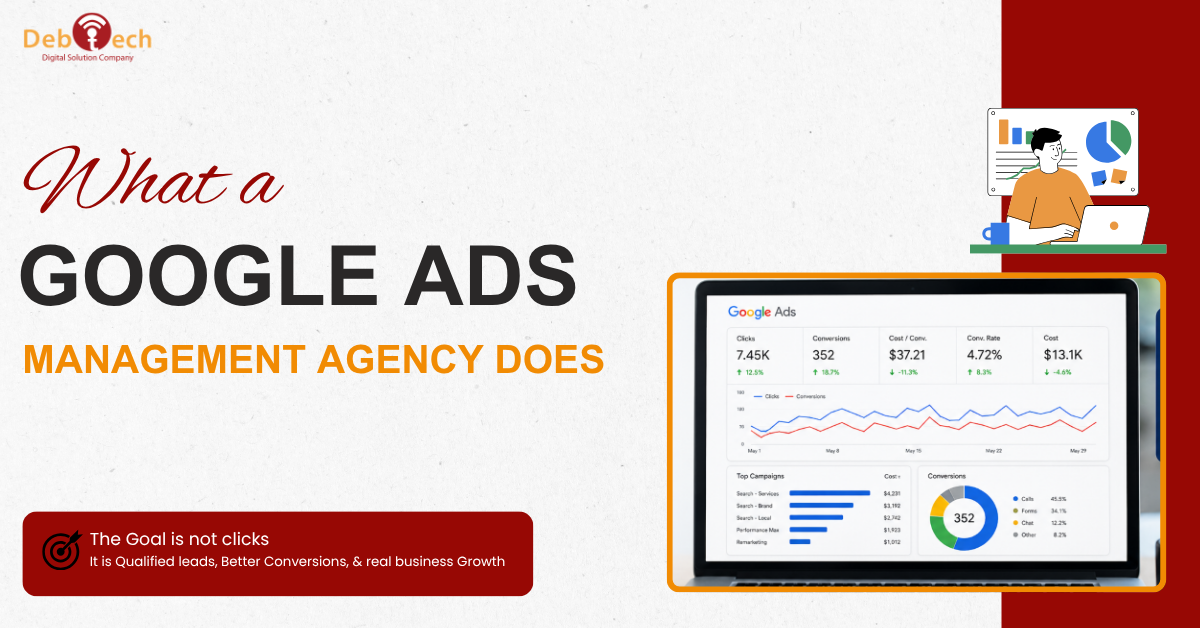
A bad Google Ads account usually does not look dramatic at first. Spend goes out every day, clicks come in, and reports show activity. The problem is that activity is not the same as growth. A google ads management agency is supposed to turn ad spend into qualified traffic, stronger conversion rates, and clear business outcomes - not just keep campaigns running.
That distinction matters more than most businesses realize. Many companies do not have a traffic problem. They have a targeting problem, a landing page problem, a conversion tracking problem, or a follow-up problem. When those issues are ignored, paid search becomes expensive fast. When they are managed correctly, Google Ads can become one of the most accountable channels in your marketing mix.
What a google ads management agency should actually manage
A real agency does more than choose keywords and write a few headlines. It manages the full system that determines whether your campaign performs. That starts with account structure. Campaigns need to be organized around services, locations, audience intent, and conversion goals. If everything is bundled together, budget control disappears and performance data gets muddy.
From there, the work moves into search intent. Not every click is worth buying. Some users are researching. Some are comparing. Some are ready to call, book, or buy. A capable agency separates those behaviors and builds campaigns around them instead of treating all traffic the same.
Ad copy is another area where weak execution shows up quickly. Good copy is not clever for the sake of it. It is specific, commercially relevant, and aligned with what the user wants right now. If someone searches for a high-intent service, the ad should reflect urgency, trust, and a clear next step.
Then comes the part many advertisers underestimate: the landing page. If the page loads slowly, buries the offer, or creates friction on mobile, campaign performance drops no matter how good the targeting is. That is why the best agencies do not treat paid media as a standalone service. They look at the page experience, mobile usability, lead form design, and conversion path because those factors directly affect return.
Why businesses hire a Google Ads management agency
Most small and midsize businesses do not need more marketing noise. They need fewer moving parts and better execution. Hiring a Google Ads management agency makes sense when internal teams are stretched, campaign performance has plateaued, or no one has the time to audit what is actually happening inside the account.
There is also a speed advantage. Google Ads can produce useful data quickly, but only if the account is built correctly. If campaigns launch with poor match types, weak negatives, broken tracking, or generic landing pages, the data becomes misleading. That leads to bad decisions made with confidence, which is one of the most expensive problems in paid media.
For local service businesses, regional targeting adds another layer. Campaigns often need to reflect service areas, business hours, local intent, and device behavior. A user searching on a phone in Northern Virginia during business hours does not behave the same way as someone researching after dinner from outside your service footprint. Strong account management accounts for that difference.
The difference between account activity and account performance
A lot of agencies report on what they did. Fewer report on what changed. Those are not the same thing.
If your agency tells you they added keywords, adjusted bids, and tested new ads, that may sound productive. But the real questions are simpler. Did lead quality improve? Did cost per qualified lead become more efficient? Did conversion rates increase? Did sales teams get better opportunities, or just more form fills from weak prospects?
That is where strategy matters. Performance management means filtering out low-value traffic, identifying the terms that produce real business outcomes, and shifting budget toward what converts. It also means knowing when not to scale. Sometimes volume goes up while quality goes down. A disciplined agency protects efficiency before it chases bigger numbers.
What strong Google Ads management looks like in practice
The best agencies work with a clear operational process. They begin with tracking and attribution because every optimization depends on trustworthy data. If calls, forms, booked appointments, or purchases are not being measured accurately, the account cannot be managed with confidence.
After tracking is verified, campaign strategy should align with actual business priorities. That may mean focusing on high-margin services, high-intent searches, or geographic pockets that convert better than others. Not every campaign should be treated equally. Budget allocation needs to reflect business value, not just traffic potential.
Optimization then becomes an ongoing discipline, not a one-time setup. Search term reviews, negative keyword expansion, bid strategy adjustments, ad testing, audience layering, and landing page improvements all play a role. Some changes produce quick wins. Others take time and enough data to validate. Good management requires both urgency and restraint.
This is also where cross-channel thinking helps. Paid search performs better when the website is conversion-focused, SEO supports service visibility, and remarketing reinforces the brand. Businesses often lose efficiency because different vendors manage disconnected pieces without coordinating around one conversion goal. An integrated team can close those gaps faster.
What to look for in a google ads management agency
Start with accountability. You want a partner that can explain what is happening in plain English and connect campaign decisions to business outcomes. If reporting is full of platform jargon but light on commercial impact, that is a red flag.
Next, look at how they think about conversion. A serious agency will ask about your sales process, your strongest services, your ideal customer, and what happens after a lead comes in. They understand that ad performance does not stop at the click. If your intake process is slow or your landing pages are weak, they should say so.
Technical competence matters too. Google Ads is not hard to start, but it is easy to mismanage. Match type control, negative keyword strategy, conversion setup, audience signals, and campaign segmentation all affect cost and quality. You want a team that can operate with precision, not one that hides behind automation and hopes the platform figures it out.
Industry context also matters, but not in a generic way. The right agency does not need to work only in your niche. It does need to understand buyer intent, lead quality, and how to align campaign structure with your operating model. A business with long sales cycles needs a different approach than one driven by same-day calls.
When a Google Ads agency is not the full answer
Paid media can drive growth, but it cannot fix every underlying issue. If your website is hard to use, your offer is unclear, or your sales follow-up is inconsistent, ads will expose those weaknesses faster. That is not a reason to avoid Google Ads. It is a reason to approach it as part of a larger revenue system.
This is where many businesses get stuck. They hire one vendor for ads, another for the website, and someone else for SEO or content. When performance slips, each partner points to a different problem. The result is fragmented execution and no real owner.
An integrated agency model solves that better because the strategy is built across acquisition and conversion, not just media buying. If the campaign needs a faster landing page, updated calls to action, or a better mobile path, the same team can move from diagnosis to implementation. That reduces delay and improves accountability.
Debtech operates from that mindset. Paid campaigns perform best when they are connected to the website, the conversion path, and the broader digital system that supports growth.
The right agency should make the business clearer
One overlooked benefit of working with a strong paid search partner is clarity. Good Google Ads management reveals what customers are searching for, which services drive action, which locations convert best, and where friction is hurting results. That insight should influence more than ad campaigns. It should shape landing pages, service positioning, and digital strategy as a whole.
If your current campaigns feel busy but not decisive, that is usually the issue. The account is generating motion without enough direction. A capable agency brings structure, sharper targeting, cleaner data, and better alignment between traffic and conversion.
The best sign you have the right partner is not that they talk more about Google Ads. It is that your business starts making better decisions because the channel is finally being managed with discipline.