
Guide to Conversion Rate Optimization for Growth
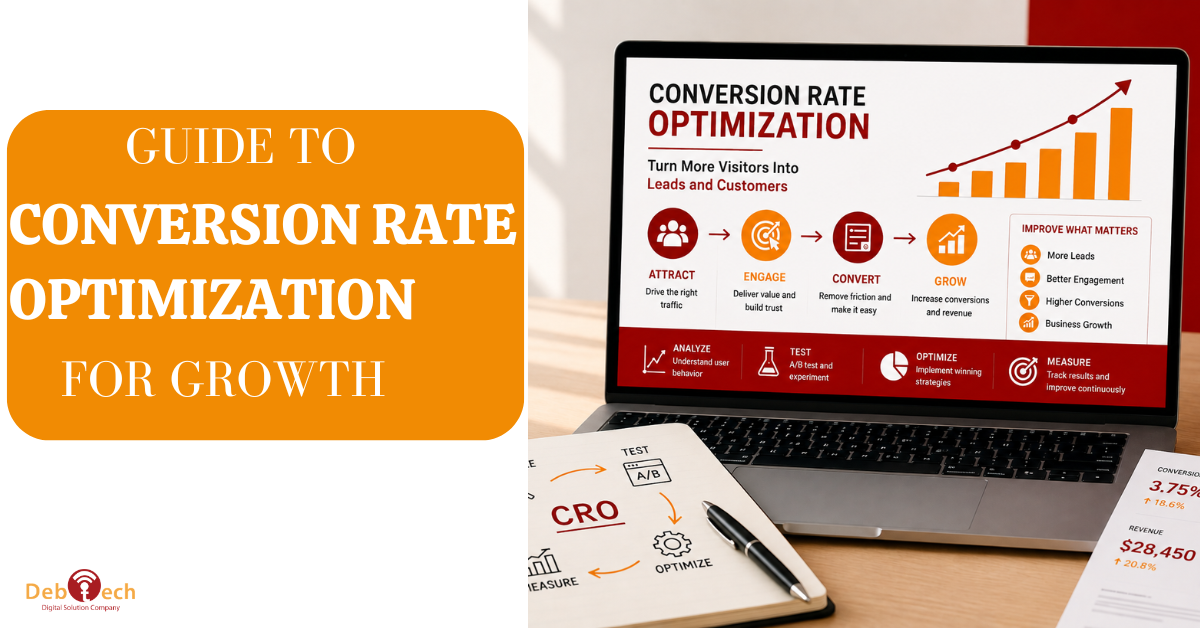
A website can attract thousands of visitors and still produce disappointing revenue if users cannot quickly understand what to do next, why they should trust the business, or how to take action. This guide to conversion rate optimization is built for business leaders who need their website, SEO, and paid traffic to produce more qualified leads and sales, not just better-looking reports.
Conversion rate optimization, or CRO, is the discipline of improving the percentage of visitors who complete a meaningful action. That action might be a form submission, phone call, booked consultation, product purchase, quote request, or demo request. The goal is not to pressure every visitor into clicking. The goal is to remove friction for the right visitor and make the next step obvious.
Start With the Conversion That Matters Most
Many businesses begin CRO by changing button colors, rewriting headlines, or adding pop-ups. Those tactics can help in the right context, but they are not a strategy. Start by defining the conversion event that moves the business forward.
For a local service company, a qualified phone call or estimate request may be the primary conversion. For an eCommerce business, it is typically a completed purchase, with add-to-cart and checkout completion as supporting actions. For a growth-stage software company, it may be a booked demo from a decision-maker rather than a generic contact form submission.
This distinction matters because a higher conversion rate is not automatically a better result. A form with fewer fields may generate more submissions but lower lead quality. A heavy discount may increase first-time orders while weakening margin or attracting customers who never return. CRO should improve profitable outcomes, not inflate surface-level metrics.
Before changing a page, document the baseline: current traffic by channel, conversion rate, conversion volume, cost per lead or acquisition where applicable, lead quality, and revenue generated. Without a baseline, it is easy to mistake normal variation for progress.
Build a Conversion Rate Optimization Measurement System
A conversion-focused website needs reliable measurement before it needs a new test. If calls, forms, purchases, and key button clicks are not tracked correctly, the team will make decisions on incomplete data.
Track primary conversions and the steps that lead to them. For example, a service business might track landing page views, clicks on the primary call to action, form starts, form completions, click-to-call actions, and appointment bookings. This reveals where prospects lose momentum.
Channel context is equally important. Visitors from branded search often convert differently than visitors from a broad paid campaign. Organic visitors may spend more time researching. Social traffic may need stronger proof before it is ready to act. A page that performs well for one source can underperform for another because intent is different.
Also review mobile and desktop separately. Mobile traffic frequently represents a large share of visits, especially for local searches, yet mobile conversion rates often suffer from slow pages, cramped forms, intrusive pop-ups, and phone numbers that are difficult to tap. If the mobile experience is weak, adding more ad spend simply sends more prospects into a leaky funnel.
Validate data before acting on it
Check that form confirmations fire consistently, phone tracking is configured accurately, duplicate events are not inflating totals, and thank-you pages or purchase events are attributed correctly. Test the full path yourself on multiple devices. A broken form field can quietly cost leads for weeks if no one owns measurement quality.
Find Friction Before You Propose a Fix
Strong CRO begins with evidence. Analytics can show that a landing page has a low conversion rate, but they rarely explain why. To identify the cause, combine quantitative data with direct observation.
Review behavior flows to see where visitors exit. Examine page speed, especially on mobile. Read sales-call notes, chat transcripts, customer emails, and form responses. Watch session recordings or heatmaps when available. These sources often point to practical issues: a confusing offer, a missing service area, an unclear next step, a form that asks for too much, or a page that loads critical content too slowly.
For businesses in competitive local markets such as Northern Virginia, trust gaps are especially costly. A prospect comparing several providers may leave when a website does not clearly show credentials, relevant experience, reviews, response expectations, or a simple explanation of the process. They are not necessarily rejecting the service. They may be postponing a decision because the site has not earned confidence.
Look for friction in four areas:
- Clarity: Can a first-time visitor explain what the business offers, who it serves, and what makes the offer relevant within a few seconds?
- Relevance: Does the page match the visitor's search query, ad message, location, industry, or stage of buying intent?
- Trust: Does the page provide specific proof through case evidence, testimonials, certifications, recognizable clients, process details, or accurate claims?
- Effort: Is the desired action simple to complete on a phone, with minimal fields and no unnecessary barriers?
The best opportunities usually appear where high-intent traffic meets obvious friction. A page with substantial paid-search traffic, a strong click-through rate, and poor lead conversion deserves attention before a low-traffic page with limited commercial value.
Improve the Page Around the Decision
A conversion page should help the visitor make a decision, not make them work to understand the business. The headline should connect directly to the visitor's need. The supporting copy should explain the outcome, the audience served, and the reason to believe the claim.
A clear primary call to action is essential. Avoid giving equal visual weight to five different actions. If the page objective is a quote request, make that action prominent and repeat it naturally as the page answers likely objections. A secondary action, such as calling the office or viewing work, can support visitors who need more confidence before converting.
Page structure should follow buying logic. Start with the promise and the immediate action. Then establish relevance, explain the service or product, show proof, reduce risk, and make the next step easy again. This is more effective than leading with a long company history or a generic list of capabilities.
Forms deserve special attention. Ask only for information the team needs to respond effectively. Longer forms can qualify leads, but every additional field creates friction. For high-consideration services, a short form followed by a well-run intake process may outperform an exhaustive form. For complex projects, a few qualifying fields can protect sales time. The right balance depends on the sales process and the value of a qualified opportunity.
Test One Meaningful Change at a Time
Testing turns CRO from opinion into an operating discipline. Create a hypothesis that ties a specific change to an expected outcome. For example: “If we replace a generic homepage headline with a service-specific value proposition, qualified form submissions from paid search will increase because visitors will see a closer match to their intent.”
Prioritize tests based on potential business impact, confidence in the evidence, and implementation effort. Start with pages that receive meaningful traffic and directly influence revenue. Common high-value tests include refining offer language, simplifying forms, improving mobile layouts, strengthening proof near the call to action, clarifying service areas, and aligning landing page copy with ad groups.
Do not declare a winner after a few conversions. Small samples can produce misleading swings. Run tests long enough to account for normal traffic patterns and evaluate results beyond the top-line conversion rate. Did lead quality hold steady? Did sales follow up? Did the improvement work across devices and traffic sources? A test that creates more low-intent leads may increase workload without increasing revenue.
Not every test needs a formal A/B setup. Some fixes are clear enough to implement immediately, such as repairing broken tracking, improving load speed, correcting an unclear phone number, or making a call button usable on mobile. Reserve controlled testing for choices where the better answer is uncertain.
Connect CRO to SEO, Paid Media, and Follow-Up
Conversion rate optimization works best when it is connected to the rest of the digital system. SEO brings visitors with specific search intent. Paid media creates immediate opportunities to test offers and landing-page messages. Website development determines performance, usability, and technical reliability. Sales follow-up determines whether a strong lead becomes revenue.
A common mistake is treating these functions as separate vendors and separate reports. The SEO team reports rankings, the ad team reports clicks, the web team reports completed pages, and no one owns the commercial result. An integrated approach makes it easier to see the full path from search query to landing page to lead to sale.
Speed of follow-up also affects conversion performance. If a prospect requests information and waits too long for a response, the website may be blamed for a problem that begins after the form submission. Review the full lead-handling process, including notification delivery, response time, routing, and the quality of the first conversation.
Make CRO an Ongoing Revenue Practice
The highest-performing websites are not finished when they launch. Buyer expectations change, competitors adjust their offers, traffic sources shift, and new customer objections emerge. A monthly review of conversion data, sales feedback, and page performance creates a practical cadence for improvement.
For businesses that need one accountable team across web development, search visibility, paid acquisition, and conversion execution, Debtech approaches CRO as part of a connected growth system. The work should lead to clearer decisions, stronger lead quality, and measurable movement in the numbers that matter.
Your next improvement does not need to be dramatic. Choose one high-intent page, verify its tracking, identify the clearest point of friction, and make a change that helps a real prospect take the next step with confidence.